
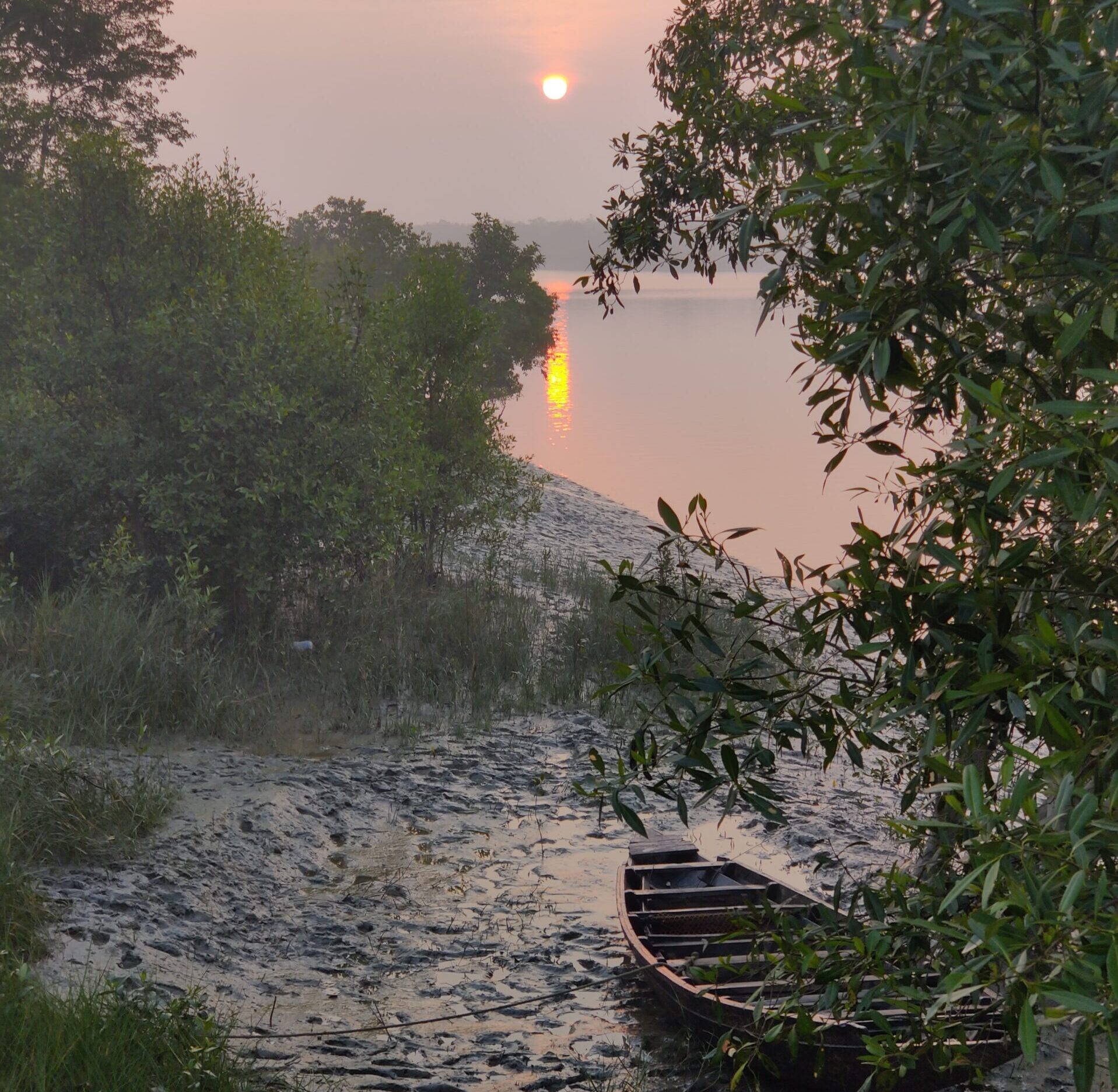
The beautiful glimpse of frozen Sikkim
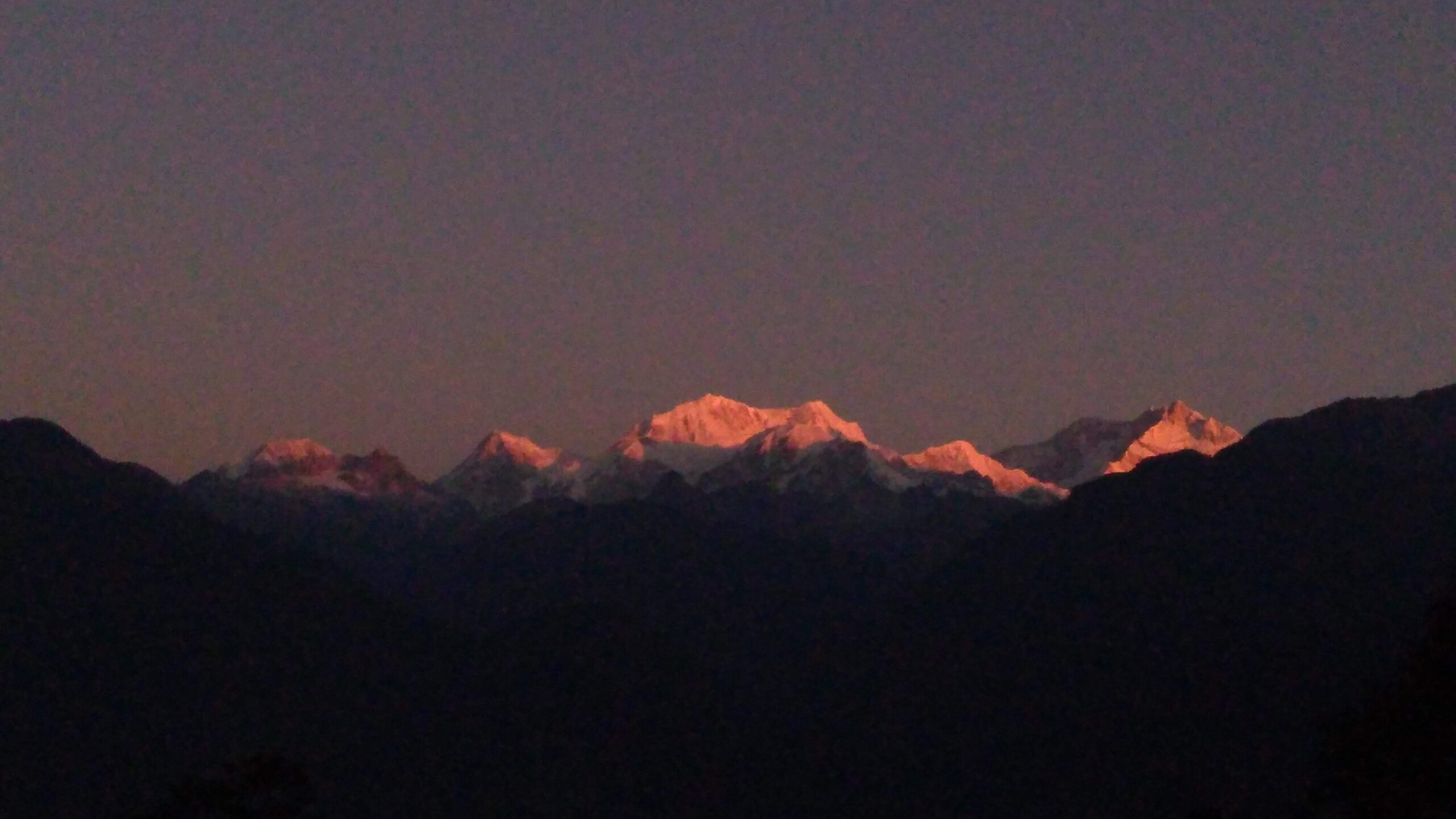
Sikkim is the North-Eastern corridor and the gateway to the highest peak in India and 3rd highest on Earth Kangchenjunga. It borders Tibet in the north and northeast, Bhutan in the east, Nepal in the west, and West Bengal in the south. Sikkim is also located close to India’s Siliguri Corridor near Bangladesh. Sikkim is a multilingual Indian state, Sikkim has 11 official languages: Nepali, Sikkimese, Lepcha, Tamang, Limbu, Newari, Rai, Gurung, Magar, Sunwar and English. The People of Sikkim consist of three ethnic groups, Lepcha, Bhutia, and Nepali. In the land of Sikkim Hindu Temples coexist with Buddhist Monasteries, Churches, Mosque and Gurudwara. All Communities, Lepchas, Bhutias, and Nepalese are very helpful and friendly. Sikkim has many monasteries and you will see many Buddhist monks and students on your way.
Sikkim has four districts – East Sikkim, North Sikkim, South Sikkim and West Sikkim. The district capitals are Gangtok, Mangan, Namchi and Gyalshing respectively. Every district of Sikkim is beautiful and uniqueness of sikkim, in every season it looks different. The best time to visit Sikkim would be in spring, from March to May. If you want to capture the picture-perfect view of the Himalayan Range, then October to December is the best season to visit Sikkim. Please avoid monsoons, from July to September due to bad weather and landslides. The Plan of the Sikkim tour will depend on the individual’s objectives i.e. Adventure, holidays, or photography. Whichever you choose I am definite that Sikkim will not disappoint you.
We like to visit Sikkim in winter to enjoy the freezing atmosphere and snow, every year we plan for Sikkim and for some other reason the plan will drop. This time few of our family friends joined us and we started planning a month before the journey. It’s like my dream come true and I started putting the names of each place I want to visit, Pelling, Ravangla, Namchi, Gangtok, Lachen, Lachung, Yumthang, zuluk. On our first planning meeting, all excitement vanished. We will get a maximum of 8 days not a full 15 days, so need to cut short and drop the few places for next time. After discussion, we arrived at a plan to start from Bangalore – Bagdogra – Sikkim.
Sikkim is connected through Siliguri. Siliguri is well connected by flight, train, bus, and every other way. Recently 4 October 2018 flight service started for Sikkim Pakyong Airport. Only Spice Jet has started its operations from Pakyong with Kolkata (SG 3324) and Guwahati (SG3326). Druk Air plans to launch flights between Pakyong and Paro this year.
If you have one or two extra days and a pack of loving friends, plan for Bangalore to Kolkata early morning flight. Put your luggage in the Sealdah station, a quick tour of Kolkata esplanade, Parkstreet, and Maidan, with delicious nawabi dum biryani for lunch. Pack some for night dinner back to Sealdah station by 7:30 take Kanchankanya EXP/ Darjeeling Mail to NJP. From the NJP you will get a taxi to Gangtok, Pelling, Kalimpong, and Darjeeling.
Due to dense fog, the train reached around 2 pm, almost 5hr late. We had a planned jungle safari scheduled at 3PM on the same day at Lataguri/ Gorumara National Park, but we missed it due to a long delay. Upon arriving at the resort, we discovered that the next two days of safari were fully booked, leaving us with no opportunity to witness India’s one-horned rhinoceros. We are planning to proceed to our next destination, Pelling, which is 165 km away and will take approximately 6 to 8 hours to reach. Along the way, you have the option to explore Singtam, Namchi, and Ravangla. Rangpo can be visited as a day trip from Gangtok. To minimize extended journeys on mountainous roads, tourists prefer using Gangtok as the central point for their complete tour, allowing them to visit East, South, and West Sikkim. If you have limited days and numerous places to visit, opting for a circular trip is advisable. Consider staying overnight in Namchi to mitigate the risk of mountain sickness. It is recommended to carry camphor and Vitamin E capsules, as they are effective against low oxygen levels and altitude sickness. Afternoon lunch, refrain from searching for large restaurants or motels. Be prepared to adapt to local options such as noodles, waiwai, and momos (Indian dumplings) served with hot soup. It’s advisable to carry biscuits, cakes, chocolates, and potato chips with you at all times. In case you miss a locality, the next available one might be at least 1-2 hours away from your current location.
After our night stay in Namchi, we commenced our journey to Pelling, making a stop at Tathagata Tsal (Buddha Park) in Ravangla. The sight of the 130-foot (40 m) high Buddha statue at the center, against the backdrop of the mesmerizing view of Kanchenjunga, compelled my hand to keep capturing the beauty. At that moment, I felt a sense of relief and happiness that my DSLR didn’t require film, preventing me from running out of shots. While photography isn’t allowed inside the peace center, it’s a must-not-miss opportunity to immerse oneself in the stories of Gautam Buddha depicted there. The Cho Djo Lake, nestled within the complex and surrounded by forest, adds to the serene ambiance.
Darkness descends upon the mountain sky quite early, and during winter, 5 pm can resemble 9 pm in this region. Navigating without a local driver can be challenging. Despite the enveloping darkness, we managed to reach Pelling at 6 pm on December 30, 2018. In the chilling -4-degree weather, a barbecue and campfire created a delightful combination. Upon request, our hotel manager, Deepak, swiftly organized a campfire with a barbecue. Finishing dinner early, I set an alarm for 5:30 am, as the sunrise was scheduled for 6:07 am the next day. Luck was on my side this time – I woke up to a clear sky, and my wish was granted as I witnessed the first rays of the sun touching the tip of Kanchenjunga.
The Chenrezig statue in Pelling stands as the fourth tallest statue in Sikkim, soaring to a height of 137 feet in West Sikkim. “Chenrezig” symbolizes the compassion of all Buddhas, with his name translating to “One Who Looks with an Unwavering Eye.” Adjacent to the statue, a unique feature is the glass skywalk, offering visitors the thrill of walking on glass. This skywalk marks India’s first glass skywalk, providing a distinctive experience for those who appreciate breathtaking views.
We arrived in Gangtok on the night of December 31st, only to discover that the hotel had delegated the New Year’s Eve celebration to a third party, excluding kids. Choosing to celebrate among ourselves in the rooms, we received good news that the government had extended permits to Tsongmo Lake and the new Baba Mandir. Planning to explore these destinations on January 2nd, we focused on local sightseeing and shopping on the 1st.
To gain a bird’s eye view of Gangtok, we enjoyed a short ropeway ride with three terminals along a one-kilometer route. The lower terminal in Deorali, a Gangtok suburb, served as the boarding point, while the intermediate terminal at Nam Nang was situated in central Gangtok next to the Sikkim Legislative Assembly. The upper terminal, just below the Tashiling secretariat, completed the journey. Two cabins, each accommodating 25 passengers, ferried commuters between the terminals. Descending to Gangtok Suburb/Lal Bazar via the ropeway, we explored this vibrant market for souvenir shopping, including good quality winter wear at reasonable prices.
Among the notable sights was a golden stupa housing the relics of the 16th Karmapa. Across from the stupa stood the Karma Shri Nalanda Institute for Higher Buddhist Studies, complete with student hostels. A unique attraction was the Wish Tower, where your wish could come true if your coin landed on top of the tower. The upper terminal, situated just below the Tashiling secretariat, facilitates the ropeway journey with two cabins ferrying commuters between the three terminals, each accommodating 25 passengers. Descending to Gangtok Suburb/Lal Bazar via the ropeway provides an opportunity for memorable shopping, offering good quality winter wear at reasonable prices.
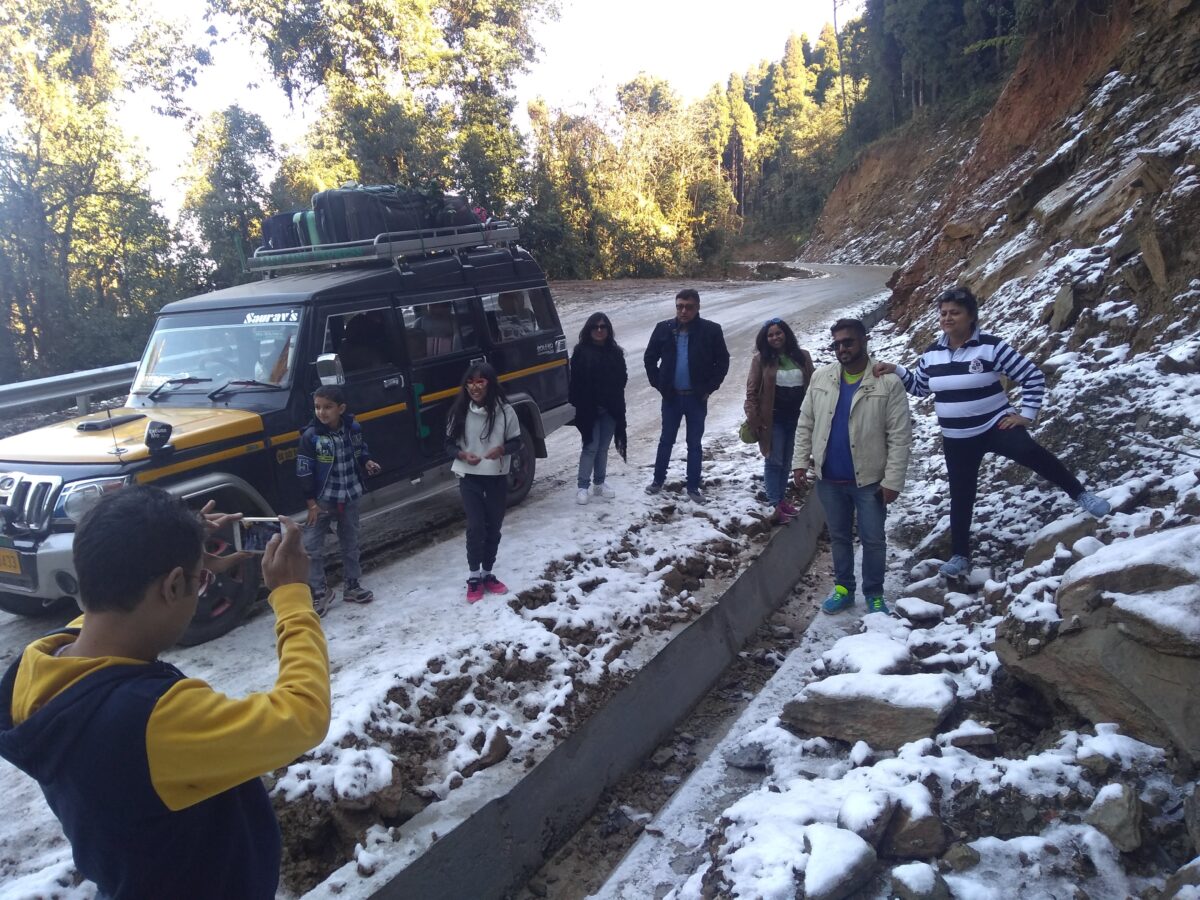
The following morning, our driver arrived with a happy face, announcing the approval of our permit to visit Tsongmo Lake and the new Baba Mandir. Although Nathula Pass approval was not obtained, we were grateful for the approved destinations. Acting on our driver Bhim Daju’s advice, we set out promptly to make our snowman. As we ascended the hills, it felt as though someone had draped all the mountains and water bodies in a white cloth.
The temperature at the new Baba Mandir was -7 degrees Celsius, causing discomfort, especially for the kids facing stomach pain due to low oxygen levels and high altitude. Despite the challenging conditions, seeing our national flag and the Indian army personnel made us feel safe and proud. The dedicated army personnel, seemingly unaffected by the weather, assisted people in stabilizing. As the weather deteriorated, we were compelled to move down to Tsongmo Lake.
Also known as Changu Lake, Tsongmo Lake sits at an elevation of 3,753 m (12,313 ft), surrounded by snow-covered steep mountains during winter. In the summer, the melting snow forms the source of the lake. The Bhutia name Tsomgo is derived from ‘Tso,’ meaning “lake,” and ‘Mgo,’ meaning “head,” giving it the literal meaning of “source of the lake.”
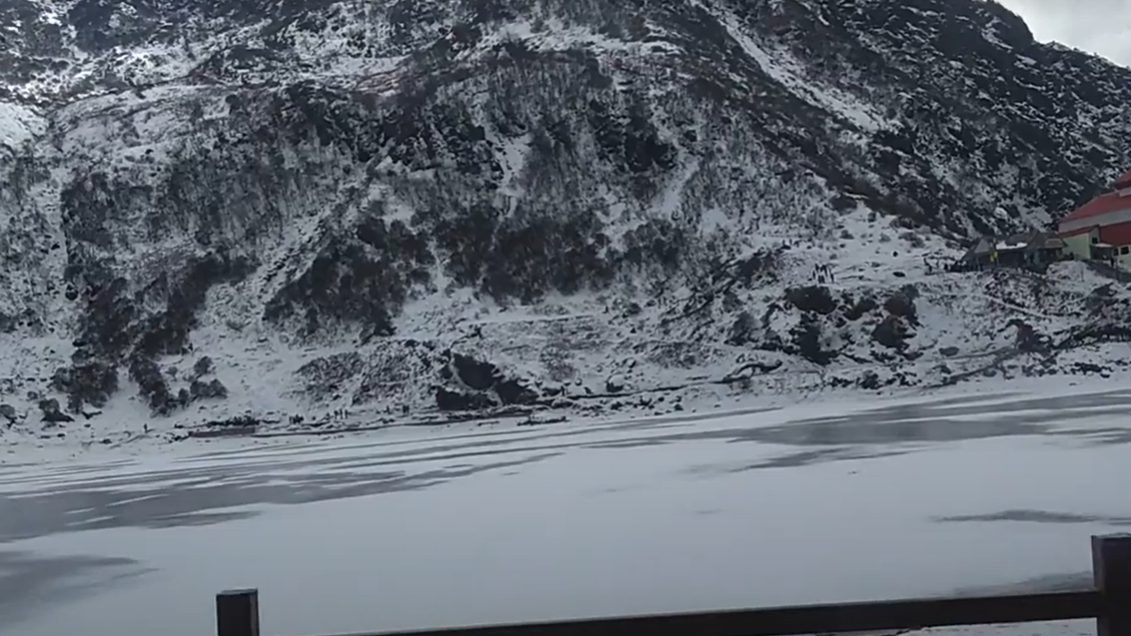
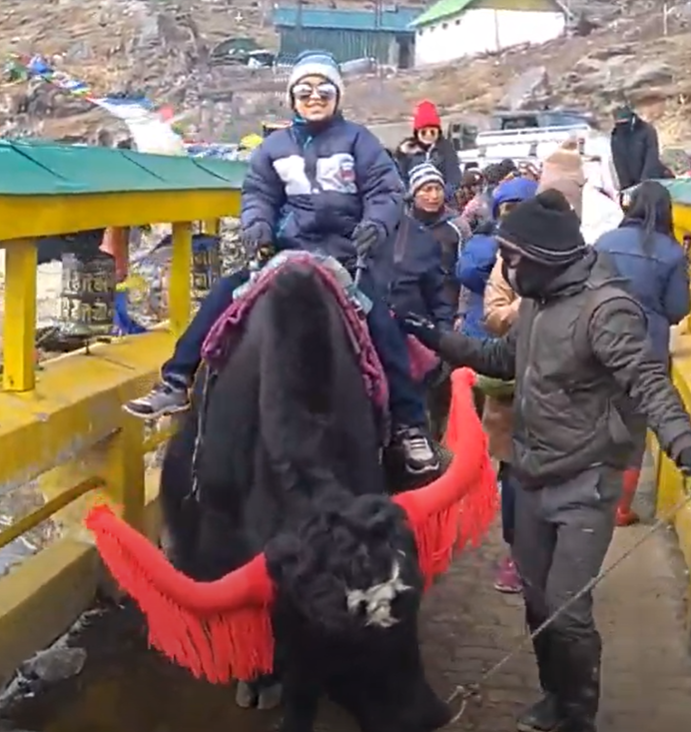
The surface of Tsongmo Lake reflects different colors with the changing seasons, holding great reverence among the local Sikkimese people. Buddhist monks make predictions based on the lake’s shifting colors. During our visit, we observed that the lake was almost frozen, with some water remaining on the north side. The slippery, icy path was navigable only by yaks. As we looked back toward Baba Mandir and Nathula Pass, we noticed the area behind us was rapidly covered by clouds and fog. Locals, army personnel, and our driver urged us to descend to lower lands promptly. On the way back to Gangtok, we enjoyed hot Waiwai chicken soup, providing much-needed warmth and energy. Alcohol, although tempting, offers only temporary relief. Instead, we practiced slow breathing, particularly as one of our kids experienced nosebleeding—a common occurrence in these conditions. Staying together and keeping the kids warm became a priority. Mobile reception was scarce due to the fog and snow conditions.
Departing with fond memories and stomachs full of soupy Waiwai, momos, cheese omelets, and hot coffee, we realized that planning for north and east Sikkim is best done in the summer. Our hope is to cover Lachen, Lachung, Yumthang, Zuluk, and Nathula Pass during that season. The next afternoon, we had a flight to Bangalore from Bagdogra. Despite unavoidable delays, we made the most of the time in Siliguri’s Hong Kong Market, engaging in some additional shopping. Finally, with an 8-hour delay, we reached Bangalore with good memories of our Sikkim adventure.
It sounds like you had a truly wonderful trip! Special thanks to your friends, families, hotel managers, trip advisory, and your driver, Bhim Chhetri, for contributing to the success of your memorable journey. May you cherish the moments and memories from this trip for a long time to come! If you have any more travel stories or if there’s anything else you’d like to share, feel free to let me know. Safe travels!